

Most permit-to-work systems look robust on paper. Forms are complete, procedures are approved, and roles are defined. Yet incidents still occur in environments where permits exist.
The system existed. It just did not hold.
This is rarely because the system is missing. It is because the system behaves differently under pressure. As pressure increases, systems used to coordinate work activity begin to degrade. Permit boards that depend on manual updates are particularly vulnerable to this, as examined in Permit Boards and Work Visibility: Why Coordination Often Breaks Down.
A simple coordination layer can prevent the visibility breakdown that follows. The SIMOPS Operational Visibility Tracker provides that coordination layer in a practical operational format.
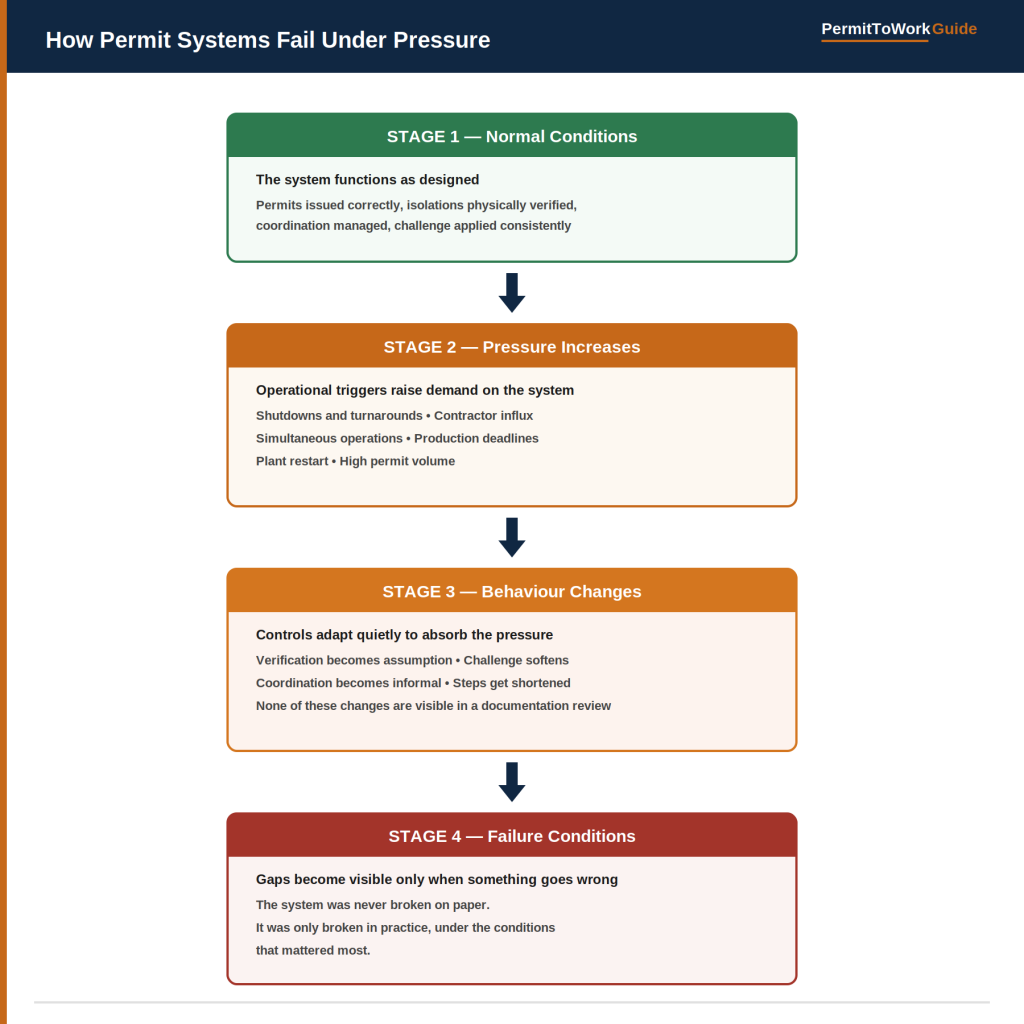
The Gap Between Design and Reality
Permit systems are typically designed for controlled conditions, adequate staffing, stable schedules, clear task scope, and uninterrupted supervision. Real operations rarely look like this.
Pressure enters the system through time-critical shutdowns, competing work fronts, resource constraints, fatigue and shift changeovers, and restart urgency. When pressure increases, behaviour changes first, not paperwork.
The failure patterns this produces are examined in Common Permit-to-Work Failure Patterns Across Industries.
What Changes When Pressure is Applied
Under time and production pressure, small adjustments become normalised. Five conditions drive operational drift in permit systems:
- Verification becomes a formality – checks are completed because the process requires them, not because someone has physically confirmed the condition
- Challenges soften under time pressure – issuing authorities ask fewer questions when the site is busy and the pressure to proceed is visible
- Assumptions replace physical confirmation – if the paperwork has been completed, the physical state is assumed to match it
- Coordination relies on individual awareness rather than a system – people know what they have authorised, but nobody has a complete picture of what is active across the site
- Shortcuts become normalised before anyone notices – each small adjustment feels reasonable in isolation; together they quietly degrade the system’s protective value
How this drift affects the transfer of operational control between shifts is examined in Shift Handover in Permit Systems: What Gets Lost Between Shifts.
None of these feel unsafe in isolation. Together, they quietly degrade the system’s protective value. This is how permit systems drift, not suddenly fail.
These conditions also increase the likelihood of multiple activities overlapping without full coordination. This is most evident during simultaneous operations, where interactions between permits become a primary source of risk, as explored in SIMOPS and Permit-to-Work: Managing Overlapping Risks in High-Hazard Operations.
The pressure to proceed when jobs cannot meet minimum isolation standard is one of the clearest examples of this dynamic. How a structured ALARP assessment manages that pressure is examined in ALARP and Permit-to-Work: How to Assess Risk When Minimum Isolation Cannot Be Met.
Why Audits Don’t Catch This
Traditional audits focus on document completeness, permit counts, signature presence, and procedural compliance. They rarely explore how decisions are made under constraint, where judgement substitutes control, how often work proceeds despite uncertainty, or what people do when the system slows progress.
As a result, organisations can be fully compliant and still vulnerable.
The audit confirms the system exists. It cannot confirm the system works.
A more effective audit approach is outlined in How to Audit a Permit-to-Work System: The Operational Approach.
Permit Failure is Rarely a Single Error
Most serious permit-related incidents trace back to cumulative weak signals, degraded controls over time, mismatched assumptions between roles, and unchallenged shortcuts becoming routine. These are systemic conditions, not individual mistakes.
Blame doesn’t fix them. Visibility does.
A Different Way to Look at Permit Health
A healthy permit system is not one that works perfectly when conditions are ideal. It is one that degrades predictably, makes pressure visible, supports challenge when it matters, slows work safely when needed, and holds integrity during handovers and restarts.
Seeing this requires structured reflection, not more rules.
A practical framework for stress-testing a permit system is outlined in How to Stress-Test a Permit-to-Work System: Finding Weaknesses Before Incidents Do.
Key concepts are summarised in the Permit-to-Work Reference Guide.
Why This Matters Before Incidents Occur
By the time a permit-related incident happens, the system has often been fragile for some time. The opportunity lies before failure, when controls still exist, behaviours are adjustable, assumptions can be challenged, and learning is low-consequence. That is the moment where structured self-checks add value.
The 3-minute Permit System Pressure Test highlights where permit controls weaken under operational pressure.
For organisations looking to examine how their permit system behaves under real operational pressure, a practical self-check approach is outlined in the Permit System Diagnostic Toolkit.
Assessing Permit Systems in Practice
For organisations that want to assess how their permit-to-work system performs under real operational conditions, see Permit-to-Work System Review (Northshore Safety Services).