

Permit-to-work systems invest heavily in stopping work safely. But the point at which most energy and risk re-enter the system is not authorisation. It is restart.
Restart is where confidence, pressure, and incomplete understanding converge, and where permit systems are least equipped to protect against failure.
Restart Changes the Nature of Risk
During the work phase, energy is controlled. Equipment is isolated, processes are interrupted, and boundaries are clear. At restart, that stability reverses. Energy is reintroduced, controls are removed, interfaces reconnect, and responsibility shifts. The system moves from a known, constrained state back into live operation.
This transition carries real risk. It is rarely treated with the same attention as the permit that preceded it.
Why Restart is Treated as Administrative
Restart often feels like the end of the job. The work is complete, the permit is closing, and attention moves on. As a result, restart gets reduced to a final signature, a procedural close-out to finish quickly.
The permit confirms that work has happened. Not that the system is ready to return to service.
Confidence Peaks When Risk is Reintroduced
Restart usually follows work that went to plan, followed familiar steps, and produced no immediate issues. That success builds confidence. Similar jobs have restarted safely before, isolations were applied correctly, and the checks have been done many times.
So scrutiny declines. Verification feels repetitive. Challenge feels inefficient.
Risk re-enters the system at the same moment attention relaxes. This is not carelessness. It is the predictable effect of familiarity combined with pressure to resume operations. The interaction between isolation control and permit systems is explained in Lockout Tagout and Permit-to-Work: Where Isolation Control Fails.
This is exactly where a physical check matters more than a judgement call. A tag on the lockout box, intact and dated, is the one thing that does not get more reassuring with familiarity. If the tag is still intact and no more than seven days have passed since it was applied, the isolation does not need rechecking. If it has been removed, damaged, or is simply not there, that overrides whatever confidence the job has built up. The tag does not care how many times this restart has gone smoothly before.
This pattern is explored further in Why PTW Systems Fail Under Pressure and How Operational Drift Takes Hold.
Handover is Where Intent Quietly Disappears
Restart frequently coincides with handover between shifts, between teams, or between contractors and operations. Information is transferred. Intent often does not follow.
What rarely makes it across is what was difficult, what was unusual, what nearly did not work, where assumptions were relied on, and what deserves attention during re-energisation. Those weak signals are the easiest to lose and the most important to carry forward.
Restart proceeds with partial understanding, even when the permit itself is complete.
How permit systems manage the transfer of operational control at shift change is examined in Shift Handover in Permit Systems: What Gets Lost Between Shifts.
Why Restart Failures Are Rarely Seen as Permit Failures
When incidents occur at restart, they tend to be classified as operational issues, equipment failures, or process upsets. The permit system escapes scrutiny because it was followed, it was closed, and it did not obviously fail.
But restart failures are rarely caused by missing permits. They stem from loss of control during transition, where multiple activities, isolations, and handovers converge at the same time. This overlap is effectively a form of simultaneous operations, where coordination between permits becomes critical, as explored in SIMOPS and Permit-to-Work: Managing Overlapping Risks in High-Hazard Operations.
The Blind Spot in Permit Design
Most permit systems are front-loaded. Issuing logic, approval pathways, and the baseline isolation standard get attention. How work is handed back does not. How readiness for restart is assessed, how residual risk is surfaced, and how responsibility transfers at re-energisation are rarely examined with the same rigour.
The system performs well at stopping work. It performs weakly at restarting it.
These restart failures appear repeatedly across industries as part of wider permit-to-work failure patterns examined in Common Permit-to-Work Failure Patterns Across Industries.
What Distinguishes Systems That Handle Restart Well
In organisations with fewer restart-related failures, restart is treated as a distinct phase rather than a conclusion. It is a point of heightened uncertainty, not reduced risk.
These systems do not rely on the permit to close the job. They rely on it to support re-entry into live operation. Control is not added at restart. It is reasserted where confidence would otherwise take over.
Many of the same behaviours appear in effective permit system audits, where restart readiness is examined alongside isolation control and SIMOPS coordination. A structured audit approach is outlined in How to Audit a Permit-to-Work System: The Operational Approach.
Key concepts are summarised in the Permit-to-Work Reference Guide.
What Handback Actually Requires
A signature on the handback section confirms the task performer believes the job is finished. It does not confirm the equipment is ready to run.
The gap between those two things is where a lot of lost time originates. A line that has been worked on needs to be tested before it goes back into service, not assumed safe because the job is complete. Has the equipment actually been run, even briefly, before the permit is signed off as safe to de-isolate. Has water, or whatever the process fluid is, been passed through the line to check containment under real conditions rather than just visually inspected. Has the task performer asked the operator to run the equipment before signing off, rather than leaving that first run to happen after isolation has already been removed and the job has formally closed.
These are not abstract questions. A fitting that looks tight by eye and is not tight enough to hold pressure once the system runs is one of the most common ways a completed, signed-off job turns into a second job. A pump that has not been proven to run before the permit closes can fail to start at all once restart begins, costing far more time than the few minutes it would have taken to check beforehand. Both of these are handback failures, not equipment failures, even though they get logged as the second.
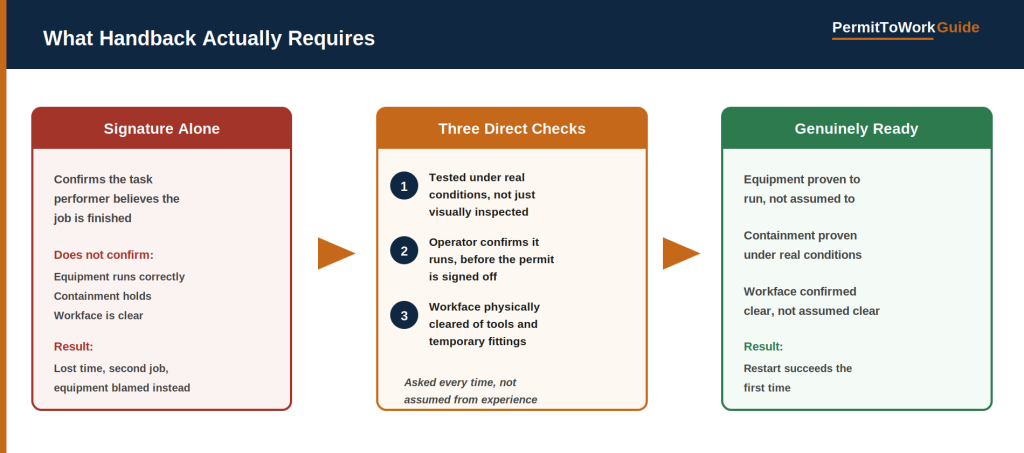
The workface itself needs the same scrutiny. Tools, temporary fittings, blanking material, and anything else brought in for the job needs to be accounted for and removed before the area is handed back. A workface that has not been visually cleared is not actually ready for restart, regardless of what the paperwork says.
None of this needs to be complicated. It needs to be specific enough that handback cannot be completed by signature alone. Has the equipment been tested under real conditions. Has the operator confirmed it runs. Has the workface been cleared. Three direct questions, asked every time, catch most of what a generic close-out signature misses. These are exactly the kind of items a structured audit should be checking for, covered in Permit-to-Work Audit Checklist: Six Areas That Reveal Operational Weakness.
Why This Matters
Restart is where routine confidence meets live energy. Assumptions get tested, controls get removed, and systems get exposed.
If a permit system does not hold firm at restart, its strength during authorisation is irrelevant. Permit systems should not be judged only by how well they stop work. They should be judged by how safely they allow it to begin again.
The 3-minute Permit System Pressure Test highlights where permit controls weaken under operational pressure, including at restart.
For a structured way to examine restart risk alongside isolation controls and SIMOPS coordination, see the Permit System Diagnostic Toolkit.
Assessing Permit Systems in Practice
For organisations that want to assess how their permit-to-work system performs under real operational conditions, see Permit-to-Work System Review (Northshore Safety Services).