

Permit-to-work failures are often treated as site-specific problems. Different industries, different equipment, different procedures. But when incidents are examined closely, a consistent truth appears. The details change. The patterns do not.
Permit systems are designed to control hazardous work activities across operating plants. For a detailed explanation of how these systems function, see The Permit-to-Work Guide: Managing High-Hazard Control of Work (2026).
Failure Patterns are Behavioural, Not Technical
Most permit systems fail without violating their own rules. The paperwork is complete. The steps are followed. The system appears compliant. What fails is not the process, but how it is used under real operating conditions.
Permit-to-work failures rarely show up in audits. They emerge once operational pressure enters the system, as examined in Why PTW Systems Fail Under Pressure and How Operational Drift Takes Hold.
These failures are behavioural and systemic, not technical. They emerge where pressure, routine, and complexity interact.
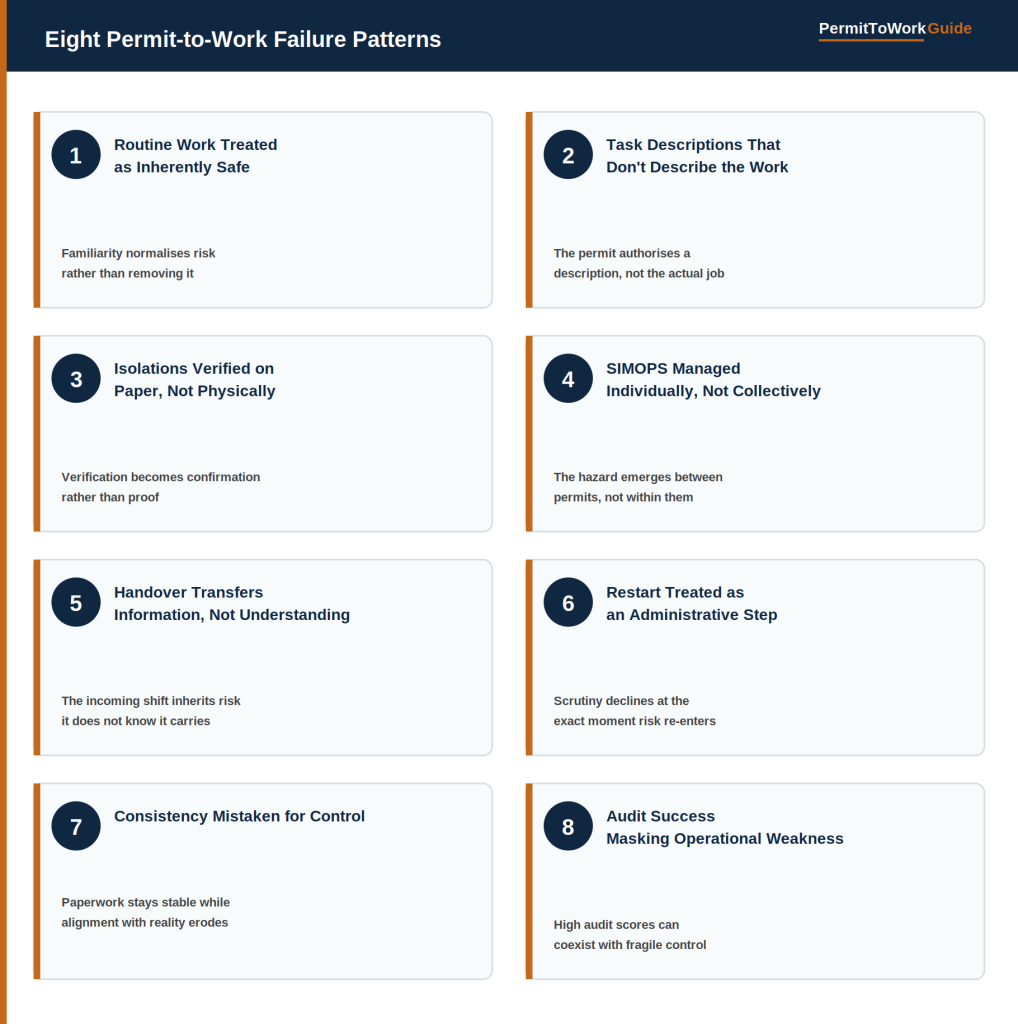
Pattern 1: Routine Work Treated as Inherently Safe
Across industries, routine work is consistently underestimated. Because tasks are familiar, hazards feel understood, controls feel sufficient, and challenge feels unnecessary. Risk is not removed – it is normalised.
This leads to shallow task descriptions, reduced verification, and reliance on memory rather than physical checks. Routine work becomes the least examined category, despite representing the highest cumulative exposure.
This pattern is examined in more detail in Routine Work Is Where Permit Systems Quietly Fail. It’s also reinforced when the challenge between permit roles weakens, as discussed in Permit-to-Work Roles and Responsibilities: Where Accountability Breaks Down.
Pattern 2: Task Descriptions that Don’t Describe the Work
Most permits describe what is being done, not how it will actually be done. Access method, task sequence, temporary states created mid-job, interaction with adjacent live systems – none of this is captured in “Replace valve” or “Inspect gearbox.”
When the work changes, the permit does not. The system ends up authorising a description of a job, not the job itself.
Pattern 3: Isolations Verified on Paper, Not Physically
Isolation failures rarely occur because isolations were omitted. They occur because isolation points were assumed rather than confirmed, labels were incorrect, valves were misidentified, or residual trapped energy remained unaddressed.
Verification becomes confirmation. The permit records that an isolation exists, not that it was tested, challenged, and proven safe.
This topic is explored further in Lockout Tagout and Permit-to-Work: Where Isolation Control Fails.
Where minimum isolation cannot be achieved, the ALARP process provides a structured basis for assessing whether work can proceed safely. This is examined in ALARP and Permit-to-Work: How to Assess Risk When Minimum Isolation Cannot Be Met.
Confined space entry is where this failure carries the most severe consequences, since the atmosphere itself can change after entry begins. This is examined in Confined Space Entry and Permit-to-Work: When the Risk Changes After Entry Begins.
Pattern 4: SIMOPS Managed Individually Instead of Collectively
Simultaneous operations are often acknowledged but not actively managed. Permits are issued in isolation, each job assessed independently, interactions considered abstractly, and cumulative risk poorly visualised.
No single permit appears unsafe. The hazard emerges between permits, not within them.
Without a shared operational picture, simultaneous operations become background noise rather than a control focus. Many of these failures occur when supervisors cannot see how different jobs interact across the site. Permit boards are intended to provide that visibility, although they often degrade over time. This is explored further in Permit Boards and Work Visibility: Why Coordination Often Breaks Down.
The coordination failures that result are examined in detail in SIMOPS and Permit-to-Work: Managing Overlapping Risks in High-Hazard Operations.
Pattern 5: Handover Transfers Information, Not Understanding
Shift handovers are one of the highest-risk points in the permit lifecycle. Not because handovers are ignored, but because the quality of what gets transferred is rarely sufficient for the incoming shift to take genuine operational ownership.
Incoming permit issuers take over without having walked the job, without knowing the history, and without understanding the conditions that existed when the permit was first issued. They rely on what is written on the permit. What is written rarely captures what actually matters.
The core failure is that handover transfers permit information rather than operational understanding. In practice this creates compounding risks: active work and changed conditions not fully communicated, isolation status assumed rather than re-confirmed, restart readiness unclear across the shift boundary, and incoming supervisors trusting outgoing judgement rather than verifying independently.
Handover quality degrades fastest under pressure. Production delays, staffing shortages, and multiple permits closing simultaneously compress the discussion at the exact moment it matters most.
Handover should transfer operational understanding, not just permit information. Where it does not, the incoming shift inherits risk it does not know it is carrying.
The full mechanics of how handover fails in permit systems are examined in Shift Handover in Permit Systems: What Gets Lost Between Shifts.
Pattern 6: Restart Treated as an Administrative Step
Across industries, restart receives less scrutiny than authorisation. Once work is complete, attention shifts to production, pressure to restore increases, and checks accelerate. Restart is framed as closure rather than exposure.
Many serious incidents occur after the permit is closed, when energy is reintroduced under conditions of confidence and time pressure. At the exact moment when risk re-enters the system, scrutiny often declines.
This topic is explored in Plant Restart: Managing the Most Dangerous Phase of the Permit Lifecycle.
Pattern 7: Consistency Mistaken for Control
Permits that look the same each time feel reassuring. Standard formats, familiar wording, predictable steps. But visual consistency can mask functional drift.
While permits repeat, systems age, interfaces shift, equipment degrades, and environments change. The paperwork remains stable while alignment with reality erodes. This is not about familiarity with the task. It is about trusting the form to represent conditions it no longer reflects.
Pattern 8: Audit Success Masking Operational Weakness
Traditional audits verify what is visible – permits exist, procedures are followed, and records are complete. They rarely reveal assumptions replacing checks, challenge quietly disappearing, or decisions compressed under pressure.
High audit scores often coexist with fragile operational control.
Recognising these patterns is only useful if the system is deliberately tested against them, as outlined in How to Stress-Test a Permit-to-Work System Before It Fails.
How these Patterns Compound
These failures rarely appear alone. Routine suppresses challenge. Confidence reduces verification. Pressure accelerates restart. Handover fragments understanding.
Consider a common scenario. A routine maintenance task is issued under a familiar permit. Isolations are assumed rather than re-tested. Simultaneous operations exist but are managed separately. Handover passes status, not uncertainty. Restart is accelerated to meet production targets.
No single step appears unsafe. Together, they remove margin. This is how permit systems fail without anyone deliberately bypassing them.
These patterns are often missed during documentation reviews. A practical way to identify them is outlined in How to Audit a Permit-to-Work System: The Operational Approach.
Why Recognising Patterns Matters
Treating failures individually produces individual responses – retraining, procedure updates, extra sign-offs. None of that addresses a system that weakens under pressure.
Patterns show where the system loses effectiveness, not where a person made a mistake. That is a different problem, and it needs a different kind of examination.
The 3-minute Permit System Pressure Test highlights where permit controls weaken under operational pressure.
If those signals appear, the Permit System Diagnostic Toolkit provides a structured way to examine how they show up across the full permit cycle.
Key concepts are summarised in the Permit-to-Work Reference Guide.
The Common Thread
Permit-to-work systems rarely fail because they are ignored. They fail because they work well under ideal conditions, weaken quietly as pressure becomes routine, and get judged on paperwork rather than performance.
Assessing Permit Systems in Practice
For organisations that want to assess how their permit-to-work system performs under real operational conditions, see Permit-to-Work System Review (Northshore Safety Services).