
Permit-to-work systems are usually documented clearly. Procedures define roles, responsibilities are written down, and approval authorities are assigned. On paper the structure appears simple and clear.
Yet when incidents occur, one of the most common findings is that the responsibilities within the permit system were not actually understood by the people involved. The issue is rarely that roles were missing. It is that the boundaries between them became blurred during real operations.
Understanding where responsibility sits inside the permit system is essential for maintaining control of hazardous work.
The broader structure of how permit systems function is described in The Permit-to-Work Guide: Managing High-Hazard Control of Work (2026).
Why Roles Matter in Permit Systems
Permit systems rely on several people performing different functions at the same time. Someone defines the job, someone authorises the work, someone applies the isolations, and someone performs the task. Each role forms a layer of challenge. When the boundaries between those roles weaken, the system gradually loses its ability to question assumptions.
This is one reason permit systems begin to degrade during routine operations and under operational pressure, as explored in Why PTW Systems Fail Under Pressure and How Operational Drift Takes Hold.
The Permit Issuer
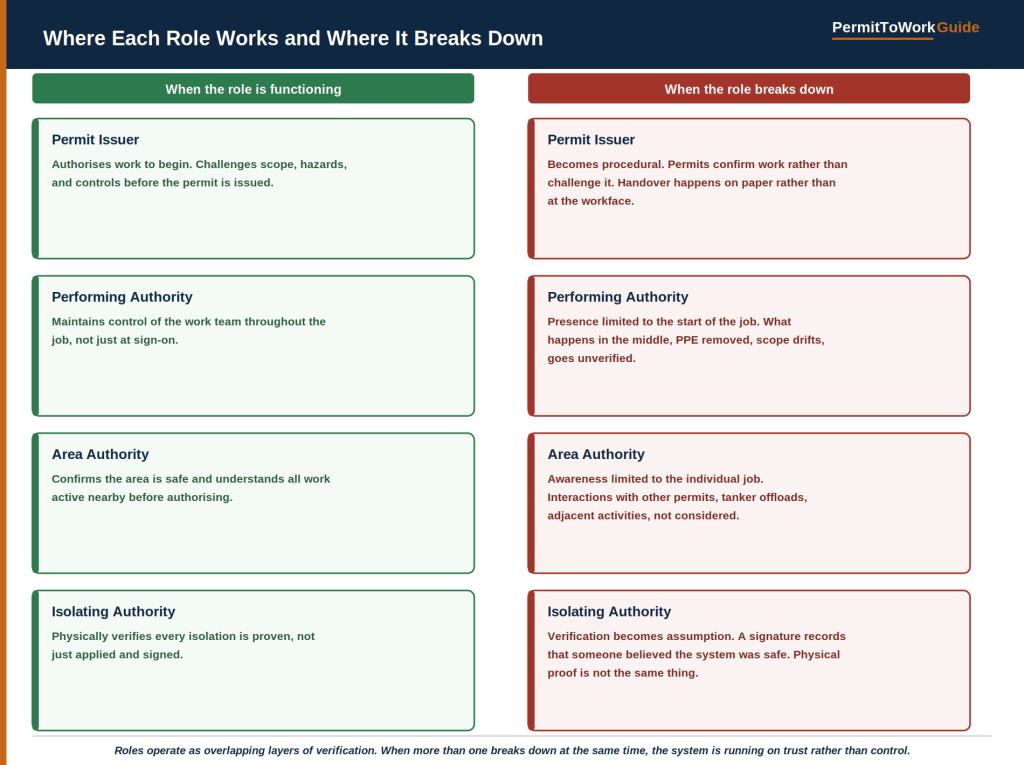
The permit issuer authorises work to begin. Their role is not simply administrative. The issuer must confirm that the job scope is understood, that hazards have been identified, and that appropriate controls are in place before work starts.
This typically includes verifying the job scope and location, hazards associated with the activity, required isolations and control measures, and interactions with other work activities.
When permit issuers operate effectively, they challenge assumptions before work begins. When the role becomes procedural, permits can be issued quickly with minimal discussion. At that point the permit begins to confirm work rather than challenge it.
Where this fails in practice: A permit issuer finishing their shift at the normal time hands over a job to the night shift without walking the work area or clearly communicating what was outstanding. The incoming shift inherits a job they have not seen, with permits that do not reflect the current state of the work. That gap between what the permit says and what is actually in the field is where the issuer’s accountability quietly transfers to whoever picks up the job next, whether they know it or not.
This drift toward routine issuing is a common pattern examined in Common Permit-to-Work Failure Patterns Across Industries.
The Performing Authority
The performing authority is responsible for the work team carrying out the task. This role ensures the workforce understands the scope of the job, the hazards involved, and the controls defined in the permit.
The performing authority also ensures the permit remains valid as work progresses. If conditions change, the permit must be reassessed before work continues.
Where this responsibility weakens, workers may begin to treat the permit as a document completed at the start of the job rather than a control that governs the work throughout its duration.
Where this fails in practice: A contractor team working under a permit removes their PPE partway through the job because it is uncomfortable or slows the work down. The permit specified that equipment clearly. The performing authority is responsible for ensuring it is worn throughout, not just at the point of sign-on. When presence at the workface is limited to the start of the job, what happens in the middle goes unverified.
This is one reason why active walkdowns during live work, not just at authorisation, are a genuine control rather than an optional practice. How contractor supervision should work in practice is examined in Contractor Management and Permit-to-Work: What Forty Contractors a Day Actually Looks Like.
The Area Authority
The area authority represents the operational owner of the plant or facility. Their responsibility is to ensure the area is safe for the work to take place and that the activity will not create risks for other operations.
This includes confirming that plant conditions are suitable for the work, that isolations affecting the area are understood, and that interactions with other work activities are controlled.
Without this oversight, permit systems struggle to manage simultaneous activities across the site.
Where this fails in practice: Contractors working in a bund had their permit issued and work underway when a tanker began offloading ammonia nearby. Neither activity was wrong on its own terms. The area authority’s responsibility is to understand what else is happening across the site before authorising work, including what is scheduled to happen during the job, not only what is happening at the moment of issue. When that broader awareness is missing, the gap between two individually correct permits becomes the hazard.
These coordination challenges are discussed further in SIMOPS and Permit-to-Work: Managing Overlapping Risks in High-Hazard Operations.
The Isolating Authority
Many permit systems assign responsibility for energy isolation to a specific role. The isolating authority ensures hazardous energy sources are identified, isolated, and verified before work begins. This includes electrical supply, stored pressure, mechanical energy, and hazardous process materials.
Isolation errors rarely involve missing locks. More often they occur when the energy state of the system is misunderstood.
Where this fails in practice: An electrically authorised person was asked to isolate a pump before a permit would be issued. They applied the isolation and then attempted to operate the equipment to prove it was isolated. It ran. Investigation found that a contractor team had recently relabelled two pumps in the switchroom. The labels were swapped. The mandatory functional verification check caught it before the permit was issued and before anyone worked on a live machine. Without that check, a signature in the isolation column would have been the only record that the isolation had been applied, and it would have been wrong.
The interaction between isolation control and permit systems is examined in Lockout Tagout and Permit-to-Work: Where Isolation Control Fails.
Why Responsibility Often Becomes Unclear
Even when roles are defined clearly in procedures, responsibility can still become blurred during real work. This often occurs when multiple supervisors share responsibility for the same area, contractors operate under different permit expectations, isolations affect several work teams simultaneously, or work continues across shift handovers.
In these situations, responsibility can become a shared assumption rather than a defined control. When this happens, the permit system continues to operate procedurally but loses the behavioural challenge that keeps it effective.
The point at which this matters most is deisolation and reinstatement. Where two people are responsible for removing different types of isolation on the same job, neither may feel fully accountable for checking that the work area is clear before the system is returned to service. That assumption, that someone else has checked, is how equipment goes back into service with a scaffold still inside it.
What Effective Permit Systems Do Differently
In organisations where permit systems remain reliable, responsibilities are reinforced through practice rather than simply defined in procedures.
Permit issuers challenge job scope and hazards before work begins and remain available at shift change rather than leaving the incoming team to read the paperwork alone. Performing authorities maintain genuine presence at the workface throughout the job, not just at sign-on. Area authorities understand what else is happening across the site before authorising any individual activity. Isolation responsibilities remain clearly assigned, with physical verification treated as mandatory rather than optional when paperwork says the job is done.
The roles operate as overlapping layers of verification rather than separate administrative steps.When any one layer is missing, the others have to catch what it missed. When more than one is missing at the same time, the permit system is running on trust rather than control.
Key concepts are summarised in the Permit-to-Work Reference Guide.
A structured way to examine how these roles operate in practice is included in the Permit System Diagnostic Toolkit.
Assessing Permit Systems in Practice
For organisations that want to assess how their permit-to-work system performs under real operational conditions, see Permit-to-Work System Review – Northshore Safety Services.